Historical Perspectives: A Look Back at United Way NEXT’s First 35 Years
In the autumn of 1989, two men sat in a conference room somewhere in America's charitable heartland, sketching the contours of what would become one of the most enduring professional networks in the nonprofit sector. Gordon Berg and Chuck Devine could not have imagined that their nascent idea for a United Way Retirees Association would evolve into something far more ambitious: a living bridge between generations of social change agents, a repository of institutional memory, and a launching pad for the next chapter of community impact.
What began as conversations between Berg and Devine in 1989, leading to incorporation in 1990 with the first newsletter launch, has metamorphosed into United Way NEXT, an organization that defies the typical boundaries of professional associations. The original vision was modest, almost quaint in retrospect: create a space for United Way retirees to maintain connections and share war stories from the trenches of community organizing. But institutions, like rivers, have a way of carving their own channels.
The early 1990s marked the organization's tentative steps toward broader influence. Members began supporting local United Ways in 1991, transforming what could have been merely a social club into an active force for ongoing change. By 1996, the annual gathering known as "Wildacres" had become institutional tradition, creating a physical space where the accumulated wisdom of decades could be passed hand to hand, story to story.
From a Simple Idea to a Growing Movement
The true measure of any organization lies not in its founding documents or mission statements, but in its capacity to evolve without losing its essential character. United Way NEXT's transformation reflects the broader shifts in American philanthropy over the past three decades. Where once the sector operated in distinct silos, with neat boundaries between donors, implementers, and beneficiaries, today's landscape demands fluid expertise and cross-sector collaboration.
The numbers tell part of this evolutionary story. Today, United Way NEXT comprises nearly 500 individual members and nearly 200 organizational members, a scale that would have seemed impossible to those first retirees gathering in the early 1990s. But scale alone misses the more profound transformation. The organization has repositioned itself as something more complex and valuable: a community where shared experiences, best practices, and relationships continue long after your time at United Way, serving professionals whether they are actively working within United Way, transitioning to a new role, launching their own venture, or enjoying retirement.
Supporting Members Throughout Their Entire United Way Journey
This expanded vision reflects a sophisticated understanding of how careers actually unfold in the modern nonprofit sector. The days when a professional might spend thirty years with a single United Way chapter, retiring with a gold watch and a pension, have given way to more fluid career trajectories. Today's United Way professionals might transition to foundation work, launch a social enterprise, consult for impact investors, or cycle between sectors entirely. United Way NEXT has positioned itself as the connective tissue that maintains relationships and knowledge transfer across these transitions.
The organization's recent programmatic achievements demonstrate this evolution in practice. In the last three years, one hundred and twenty nine matches participated in the mentorship program and ten Interim Executives were placed to provide leadership continuity during organizational transitions. These programs represent a sophisticated understanding of how expertise flows through professional networks and how institutional knowledge can be preserved and deployed strategically.
Demonstrating Impact Beyond the Nonprofit Sector
The broader context for this work has never been more urgent. Recent economic impact studies have begun quantifying what United Way NEXT members have long understood intuitively: that community investment creates measurable economic returns beyond traditional social outcomes. A November 2024 Price Waterhouse Coopers study of United Way of Southwestern Pennsylvania, believed to be among the first economic contribution studies for a human services nonprofit, demonstrates that United Way serves as a catalyst of economic impact and well-being. Similarly, United Way of Central Indiana's $135 million in investments supported 800 jobs per year worth $36 million in annual employee compensation (source).
These findings represent more than academic exercises in impact measurement. They signal a maturation of the field that United Way NEXT has both witnessed and helped shepherd. The organization's 35-year arc parallels the broader professionalization of nonprofit leadership, the integration of business practices with social mission, and the growing recognition that effective community change requires sustained, sophisticated approaches to relationship building and knowledge management.
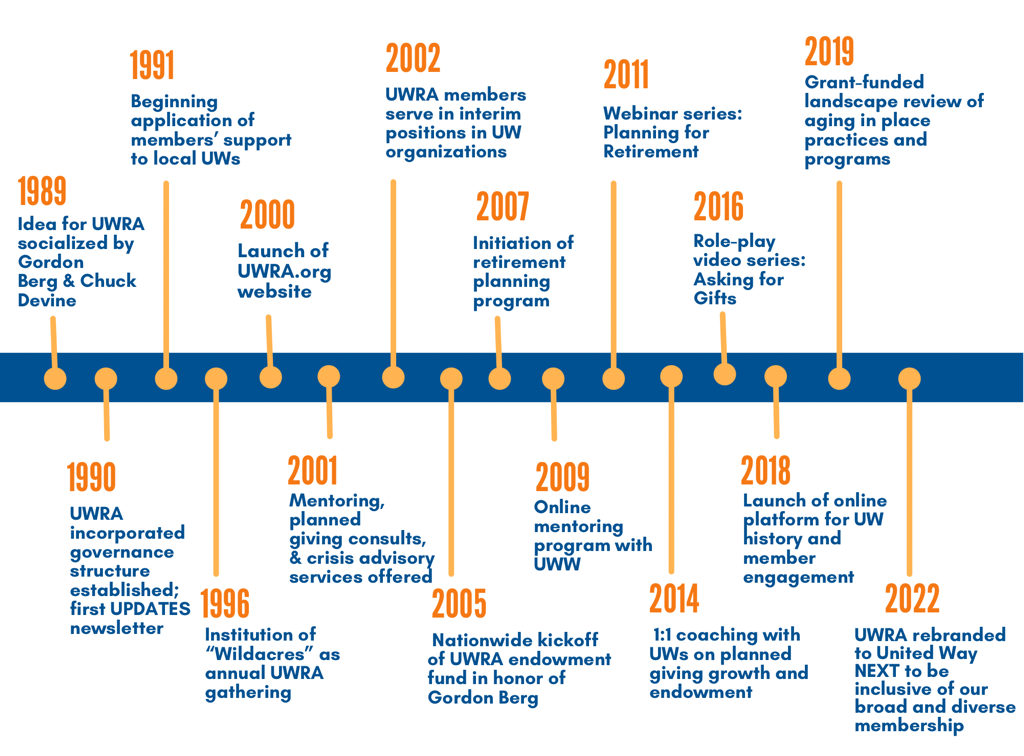
Graphic depicting the history of United Way Retirees Association up to the rebrand in 2022.
Entering the NEXT Chapter
The organization's 2022 transformation to United Way NEXT reinforced its commitment to inclusivity, ensuring that every member has a place in this community regardless of where their path leads. This rebranding was more than cosmetic; it represented a fundamental reconceptualization of what it means to be part of the United Way movement. No longer bound by employment status or retirement timing, membership became about a shared commitment to community impact across all career phases.
For 35 years, United Way NEXT has continuously evolved to meet member needs, from launching its first newsletter in 1990 to expanding mentorship, leadership, and planned giving programs. The organization operates under the philosophy of “Making Connections & Making a Difference”, with a mission to create a future where every United Way professional feels supported, connected, and empowered to drive meaningful change in their communities.
Intentionally Building Across Decades
Looking back across these 35 years, what emerges is not simply the story of a successful professional association, but a case study in adaptive leadership and institutional resilience. From Berg and Devine's original conversations to today's sophisticated network of practitioners, United Way NEXT has demonstrated that the most powerful organizations are those that remain true to their core purpose while continuously expanding their conception of how that purpose can be fulfilled.
The real legacy of these first 35 years may not be in the programs launched or members served, but in the model created: proof that professional networks can serve as repositories of wisdom, incubators of innovation, and bridges between what was and what could be. In a sector often criticized for short-term thinking and limited collaboration, United Way NEXT stands as evidence that some institutions can successfully play the long game, building across decades the kinds of relationships and knowledge systems that sustainable social change requires.
Celebrating 35 Years of Impact
As we close out our 35th Anniversary celebration, we’re incredibly grateful for the leaders and community that have carried this organization forward for more than three decades.
This year, over 150 United Way colleagues have been honored through our 35th Anniversary Campaign, raising $26,355 in tributes, sponsored memberships, and donations. Many of which were dedicated to individuals that made United Way NEXT members feel like they belonged and helped shape their journey. Plus, we received a very special gift of $13,000 to our UW NEXT Endowment from Dan and Kathleen Dunne!
If you’d like to recognize someone that helped you find your place in the United Way network, there’s still time to make a tribute and we encourage you to share your story with us 💙
About the Authors

Dick Aft, UW NEXT Emeritus Board Member (with research assistance from AI)
Following a 40-year United Way career during which Dick raised over a billion dollars to support local non-profit human services, he earned a Ph.D. in Organizational Leadership & Development. Since then, he has served as an interim United Way CEO and mentor, and he has tried to use the things he has experienced and learned.
These include coaching new presidents of colleges and universities as sole proprietor of Philanthropic Leadership. Serving as a volunteer board officer of a score of organizations, currently: the Cincinnati Chamber Orchestra, Cincinnati College Conservatory, Hoxworth Blood Center, the American National Classical Music Hall of Fame, and as Past Chairman and an emeritus board member of United Way NEXT.
Teaching Values-Based Management [ethics] to Xavier University MBA students for 10 years. Spending 10 years “Of Counsel” with Gilman Partners Executive Search specializing in filling non-profit CEO positions. Serving as a historian for the 130-year-old United Way movement. [Four books, 25 webinars, and over 70 articles published to date.] Voluntarily helping Greater Cincinnati non-profit organizations strategically identify and recruit Board Members.
Dick’s wife Mary Lu has made dozens of foundation-funded trips abroad to coach government, business, and volunteer leaders on the establishment and oversight of health and social service organizations. Many of these trips have been as representatives of the former United Way International. Two of their three sons and one daughter-in-law are former United Way CEOs. Together, they have been United Way execs for over 100 years.
Read additional articles by Dick here.