From the Archives: Unleashing the Grip of Assumption - A Leader’s Guide to Recognizing & managing Implicit Bias
In honor of our 35th Anniversary, United Way NEXT began featuring articles from past issues of the original United Way Retirees Association newsletter. With digital archives of issues dating back to 1990, we’re excited to honor the voices and history that went into building the organization we see today!
This month, we’re highlighting an article featured in the Summer 2020 issue titled “Unleashing the Grip of Assumption: A Leader’s Guide to Recognizing & managing Implicit Bias” written by UW NEXT members Roger Frick and Jeffrey Wilcox.
At this time, UWRA was celebrating their/our 30th anniversary under the leadership of Amber Kelleher, President & CEO, and Carl Zapora, Board Chair.
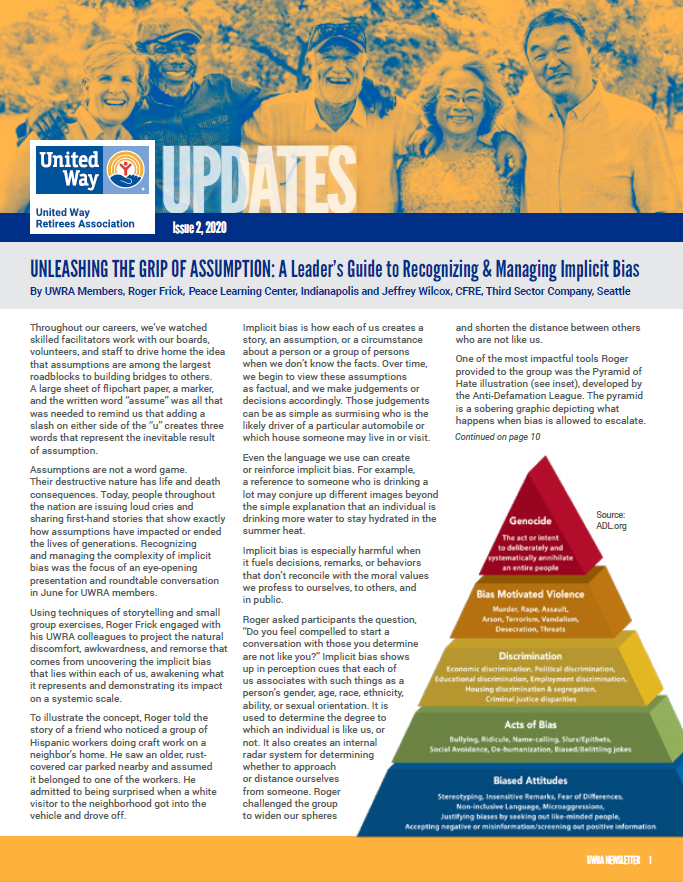
The original Updates cover and article printed in Summer 2020.
Unleashing the Grip of Assumption: A Leader’s Guide to Recognizing & managing Implicit Bias - Summer 2020
Throughout our careers, we’ve watched skilled facilitators work with our boards, volunteers, and staff to drive home the idea that assumptions are among the largest roadblocks to building bridges to others. A large sheet of flipchart paper, a marker, and the written word “assume” was all that was needed to remind us that adding a slash on either side of the “u” creates three words that represent the inevitable result of assumption.
Assumptions are not a word game. Their destructive nature has life and death consequences. Today, people throughout the nation are issuing loud cries and sharing first-hand stories that show exactly how assumptions have impacted or ended the lives of generations. Recognizing and managing the complexity of implicit bias was the focus of an eye-opening presentation and roundtable conversation in June for UWRA members.
Using techniques of storytelling and small group exercises, Roger Frick engaged with his UWRA colleagues to project the natural discomfort, awkwardness, and remorse that comes from uncovering the implicit bias that lies within each of us, awakening what it represents and demonstrating its impact on a systemic scale.
To illustrate the concept, Roger told the story of a friend who noticed a group of Hispanic workers doing craft work on a neighbor’s home. He saw an older, rust-covered car parked nearby and assumed it belonged to one of the workers. He admitted to being surprised when a white visitor to the neighborhood got into the vehicle and drove off.
Implicit bias is how each of us creates a story, an assumption, or a circumstance about a person or a group of persons when we don’t know the facts. Over time, we begin to view these assumptions as factual, and we make judgements or decisions accordingly. Those judgements can be as simple as surmising who is the likely driver of a particular automobile or which house someone may live in or visit.
Even the language we use can create or reinforce implicit bias. For example, a reference to someone who is drinking a lot may conjure up different images beyond the simple explanation that an individual is drinking more water to stay hydrated in the summer heat.
Implicit bias is especially harmful when it fuels decisions, remarks, or behaviors that don’t reconcile with the moral values we profess to ourselves, to others, and in public.
Roger asked participants the question, “Do you feel compelled to start a conversation with those you determine are not like you?” Implicit bias shows up in perception cues that each of us associates with such things as a person’s gender, age, race, ethnicity, ability, or sexual orientation. It is used to determine the degree to which an individual is like us, or not. It also creates an internal radar system for determining whether to approach or distance ourselves from someone. Roger challenged the group to widen our spheres and shorten the distance between others who are not like us.
One of the most impactful tools Roger provided to the group was the Pyramid of Hate illustration, developed by the Anti-Defamation League. The pyramid is a sobering graphic depicting what happens when bias is allowed to escalate.
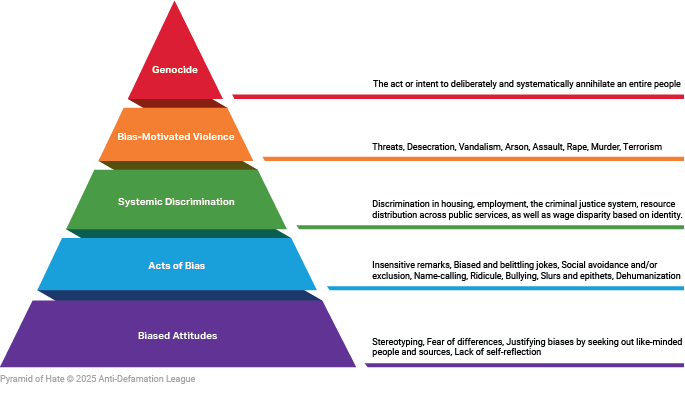
The updated Pyramid of Hate graphic developed by the Anti-Defamation League
2026 Editor Note: ADL offers a 20-minute online training on the Pyramid of Hate.
Powerful assumptions about people or situations can lead to individual acts of prejudice. Growing prejudice contributes to a culture of discrimination that can breed bias-motivated crimes against individuals and groups. At the pinnacle of the pyramid, widespread contempt, which was ignited by bias, can lead to genocide, the elimination of people, groups, or communities en masse.
The roundtable created a space for colleagues to reflect on how implicit bias might appear in their own words and actions. Some reflected on specific moments in their careers when implicit bias played an unintentional role in their leadership decision-making.
As seasoned United Way advocates, we had a thoughtful discussion about the role implicit bias might play in the most valued traditions of the organization, including the citizen-review process of fund distribution, volunteer recruitment and advancement, and campaigning in diverse workplaces and amongst diverse workers.
Everyone agreed this conversation must continue. UWRA members can and must be catalysts for reflection and tough conversations about race, equity, and elimination of bias. Individually and collectively, we have a responsibility to make a difference for future generations of United Way employees and volunteers who are in community with us. As individuals who are deeply rooted in carrying forward the mission of United Way in so many facets of our lives, we must start by challenging our own assumptions as an essential first step towards fostering sustainable, healthy, and safe communities that are the cornerstone of our life’s work.
Continuing the Journey
Nearly six years later, we’re proud to say that the UW NEXT staff, board, and work groups are still deeply committed to creating a culture of belongingness within our community. At this year’s fall retreat, we plan to reflect on the work we’ve been doing and have another tough conversation about implicit bias and the ways in which it can create institutional biases, causing members to feel uncomfortable and disconnected.
“For a membership association like UW NEXT it is critical that people feel that they belong to the community,” says Roger. And “as United Way people we know the value of each member of our community and that the contributions of all are needed in our most challenging times.”
Which is why, in the coming months, our DEIB Work Group looks forward to embracing the opportunity to grow together and “unapologetically affirm our Community Commitment by taking the NEXT steps to move from awareness to action,” adds Jeffrey. Because the fundamental truth is, “we should always be mindful of the potential presence of unintended bias, its impact on others, and what it can inadvertently (and unfortunately) communicate about ourselves to others.”
And with that, our authors have posed two very important questions:
How do we maintain a place of welcome and promise to any and all who engage with UW NEXT?
How do we appropriately lean into an awareness of bias and create a peer-based stewardship that reduces its presence and harms?
About the Authors
Roger Frick, UW NEXT Work Group Co-Chair
Roger Frick is a 35 year veteran of United Way leadership. He was the CEO of two local United Ways and served as CEO of the Indiana State Association for 15 years. Roger coached 60 United Ways in leadership, board development, and change strategies. Through a robust grant program over seventy-five million dollars was delivered to Indiana United Ways to strengthen their development and impact work.
After retirement he became active with the Peace Learning Center where he facilitated Implicit Bias workshops for over five years. He worked with educators, university search teams, doctors, church leaders, community groups, and even a group of educators in Dubai. He also facilitated implicit bias webinars for UW NEXT during covid that led to our DEIB Work Group. Roger and his wife Susan live in Indianapolis where they are active in social service and justice causes.
Roger has been a member of UWRA since 2002 and ended his 2nd 3-year term as a Board Member in 2021. He now volunteers as Co-Chair for the Diversity, Equity, Inclusion, and Belonging Work Group and previously served as a Relationship Manager. In 2012, he also participated in a UWRA work group in order to provide recommendations for a mentoring model built around the different needs of the United Way network. What once started on an “as needed” basis, has now grown into a widely used Mentorship Program with dozens of matches across three categories: CEO & Staff, Endowment & Planned Giving, and Career Transition Support.
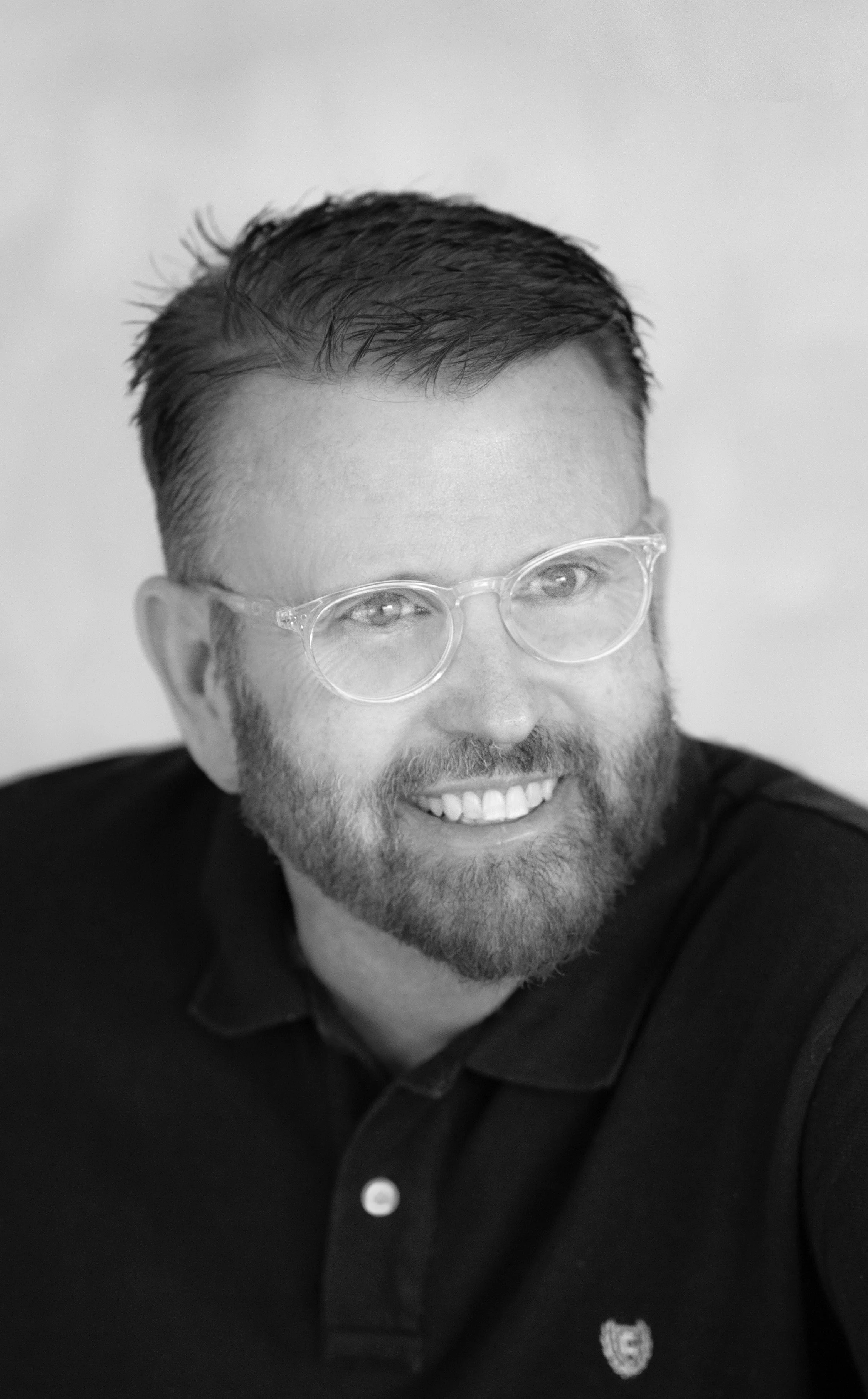
Jeffrey R. Wilcox, UW NEXT Board Member
Jeffrey Wilcox leads one of the largest teams of professionals in North America dedicated to the advancement and practice of leadership succession planning and interim executive management for nonprofit organizations, associations, and congregations. He is the founder of “Interim Executives Academy,” which has set a national standard for the methodical practice of interim leadership and has awarded certificates of completed studies in strategic transitional leadership to over 800 people across the United States and Canada.
Third Sector Company has provided leadership continuity services to over 900 nonprofits since its founding in 2002. Clients of Interim Executives Academy have included California Wellness Foundation, PetSmart Charities, California Congregations for Equality, The Canucks Foundation, Golden Gate Bridge National Conservancy, and well-known organizations serving the television, motion picture and entertainment industries and their workers. Third Sector Company has been named “A Top 10 Interim Executives Services Firm” every year by ManageHR magazine since 2023 and was featured on the front cover in 2024.
Jeffrey is the former Senior Vice President for Community Development for United Way of Greater Los Angeles, and Valley of the Sun United Way in Phoenix, Arizona, and former executive director of CHOC Children’s Hospital Foundation in Orange County, CA. He is the former nonprofit columnist for the Long Beach Business Journal, and author of “The Nonprofit Leader of the New Decade.” He co-developed and is the former lead trainer for the Wells Fargo New Executive Directors Institute of Greater Los Angeles and the Association Leadership Academy at the California Society of Association Executives. In 2022, Jeffrey was presented the “Innovation Award” by the Washington Society for Association Excellence and was given “The President’s Award” by WSAE in 2025.
He is the immediate past chair of the Executive Advisory Board for the School of Business, Government and Economics at Seattle Pacific University and was named Alumnus of the Year in 2015. He is the former governance chair for the national Camp Fire organization based in Kansas City, former chapter President of AFP Orange County (CA) and past chair of the Executive Transitions and Succession Planning Affinity Group for the Alliance for Nonprofit Management.
Jeffrey currently volunteers as a member of the UW NEXT Board of Directors, on the Diversity, Equity, Inclusion, and Belonging Work Group, and the UW NEXT Consultant Collaborative Leadership Team. In addition to being a member and volunteer of UW NEXT, Jeffrey’s organization is also a 2025 Event Programming Sponsor, he’s a founding member of the Consultant Collaborative, and has a UW NEXT-named endowment. Plus, he served on the UW NEXT CEO Search Committee in 2022.
Read additional articles by Jeffrey here.